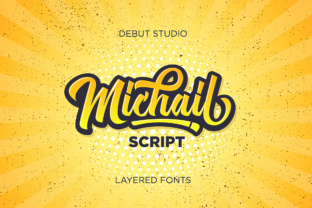
Michail Script: A Layered Approach to Passionate Design
If you've ever felt that a standard script font falls flat or lacks the depth required for a standout logo, you know the struggle of modern branding. We often spend hours trying to outline text or manually add shadows to give our typography weight and presence. This is exactly the problem Michail Script solves. It is not just a single typeface; it is a striking family of six distinct layers designed to work in perfect harmony. For the entrepreneur, the designer, and the crafter looking for that "premium font" feel without the complexity, Michail Script offers a unique, tactile aesthetic that bridges the gap between digital precision and hand-painted charm.
The Power of Layered Typography
At its core, Michail Script is defined by its construction. Unlike traditional handwritten fonts that offer a single flat weight, this family utilizes a layering system. You have the base letterforms, which are fluid and energetic, but you also have additional files that allow you to stack different textures, shadows, and outlines on top of one another. This technique is a staple in advanced logo design, but it is often difficult to execute manually.
When you use Michail Script, you are working with a cohesive system. The visual characteristics are bold, sweeping, and unapologetically expressive. The "personality" of the font is youthful and passionate, making it an immediate attention-grabber. It feels hand-lettered, carrying the organic imperfections that make modern typography feel human. However, because it is a structured premium font, it maintains a consistency that free, messy fonts cannot replicate. Whether you choose the solid base or the textured overlay, the result is a design that looks three-dimensional and professionally crafted.
Strategic Applications for Branding and Marketing
Understanding where to deploy a creative font like Michail Script is half the battle. Its bold nature means it is not suited for long paragraphs of body text—save your serif font or clean sans serif font for that. Instead, Michail Script shines in high-impact environments where brand perception is forged in seconds.
Logo Design and Brand Identity: This is the font’s home turf. If you are building a brand for a boutique clothing line, a coffee shop, or a creative agency, Michail Script provides an instant "cool factor." The layered aspect allows you to create complex visual hierarchies within a single word mark. Imagine a logo where the main text is a deep navy, but the shadow layer is a metallic gold. This level of depth creates a brand identity that feels established and premium.
Packaging and Editorial Design: In packaging design, shelf appeal is everything. Michail Script works beautifully for product names on labels for hot sauces, craft beers, or artisanal cosmetics. It screams "quality" and "craftsmanship." Similarly, in editorial design, such as magazine headers or book covers, it commands attention. It sets a tone of excitement that draws the reader in before they even read the subtitle.
Digital Presence and Web Design: While you wouldn't use it for your blog post body, Michail Script is a powerhouse for web design hero sections and call-to-action buttons. It breaks up the monotony of standard web typography. Furthermore, it is a game-changer for social media graphics. In a crowded feed, the visual texture of Michail Script stops the scroll. It is perfect for Instagram quotes, YouTube thumbnails, and Facebook headers where visual engagement is the primary metric.
Practical Guidance for Implementation
Adopting a layered font system requires a slightly different workflow than using standard text. Here is how to get the most out of Michail Script in your next project.
Mastering Font Pairing
Because Michail Script is so expressive, it demands a grounding partner. Good font pairing is about contrast. If you try to pair it with another decorative or script font, the result will be chaotic and unreadable. Instead, look for a neutral, geometric sans serif font or a traditional serif font. The clean lines of a sans-serif will allow the organic curves of Michail Script to pop. Use the script for headlines and the sans-serif for subheadings and body copy to maintain a clear visual hierarchy.
Testing for Readability
While Michail Script is designed for impact, you must always test for readability. This is particularly true for web design and packaging design. At very small sizes, the intricate details of the font’s texture might become muddy. Always print out a test sheet or view your design on a mobile device to ensure the message is legible. If the texture is too heavy at a small size, consider using the solid version of the font without the overlay layers.
Understanding the Styles
Take time to explore the six layers included in the family. You will likely find a solid version, a shadow version, an outline, or perhaps a textured overlay. In software like Adobe Illustrator or Photoshop, you can stack these design assets manually. Type your word in the base layer, duplicate the text box, change the font to the "Shadow" layer, and align them. This manual control allows you to change the color of the shadow independently of the main text, offering infinite customization.
Licensing and Commercial Use
Finally, always verify the licensing. If you are a freelancer creating a logo for a client, or a small business owner printing merchandise, you need to ensure your commercial font license covers the intended use. Most premium font licenses require an upgrade if the product is being sold in high volumes (like on t-shirts) or if the font files are installed on multiple computers. Read the specific terms of the Michail Script license to ensure you are compliant, protecting both your business and your client.
Elevating Your Creative Toolkit
Michail Script is more than just a display font; it is a design system. It caters to the hobbyist who wants to create professional-looking party invitations, the marketer who needs punchy visuals for a campaign, and the designer looking for a versatile typeface with character. By leveraging its unique layering system, you can add depth, emotion, and professionalism to your work that flat fonts simply cannot achieve. It is a reminder that in the world of design, how you present your words is just as important as the words themselves.


